
Oxygen Not Included Thermally Reactive vs High Thermal Conductivity
Oxygen Not Included thermally reactive vs high thermal conductivity explained: compare heat capacity, pipe materials, and coolants for safer base cooling.
Jump to

What’s the Difference Between Thermally Reactive and Conductive?
For Oxygen Not Included thermally reactive vs high thermal conductivity comparisons, use the numerical specific heat capacity and thermal conductivity values to choose materials. Specific heat capacity determines the energy needed for a temperature change, while conductivity describes heat transfer. Check both when selecting insulation, heat exchangers, and coolant.
These properties answer different questions when you select a construction material:
| Property | What it means | Practical effect |
|---|---|---|
| Low specific heat capacity | Less heat is required per unit mass for each degree of temperature change | A given amount of heat produces a larger temperature change in the same mass |
| High thermal conductivity | Heat passes through the material readily | Helps exchange heat where you want heating or cooling |
| High specific heat capacity | More heat is required per unit mass for each degree of temperature change | Provides greater thermal buffering and carries more heat through fixed-temperature cooling equipment |
A material can change temperature easily without moving heat effectively. Likewise, a strong conductor can require considerable energy to warm up. Check both properties instead of choosing a material from one descriptive label.
Official page: Oxygen Not Included (klei.com)
Specific Heat Capacity: How Much Heat Changes the Temperature?
Specific heat capacity measures the energy needed to raise a unit mass of material by one degree Celsius or kelvin. The size of a one-degree change is identical on those two scales.
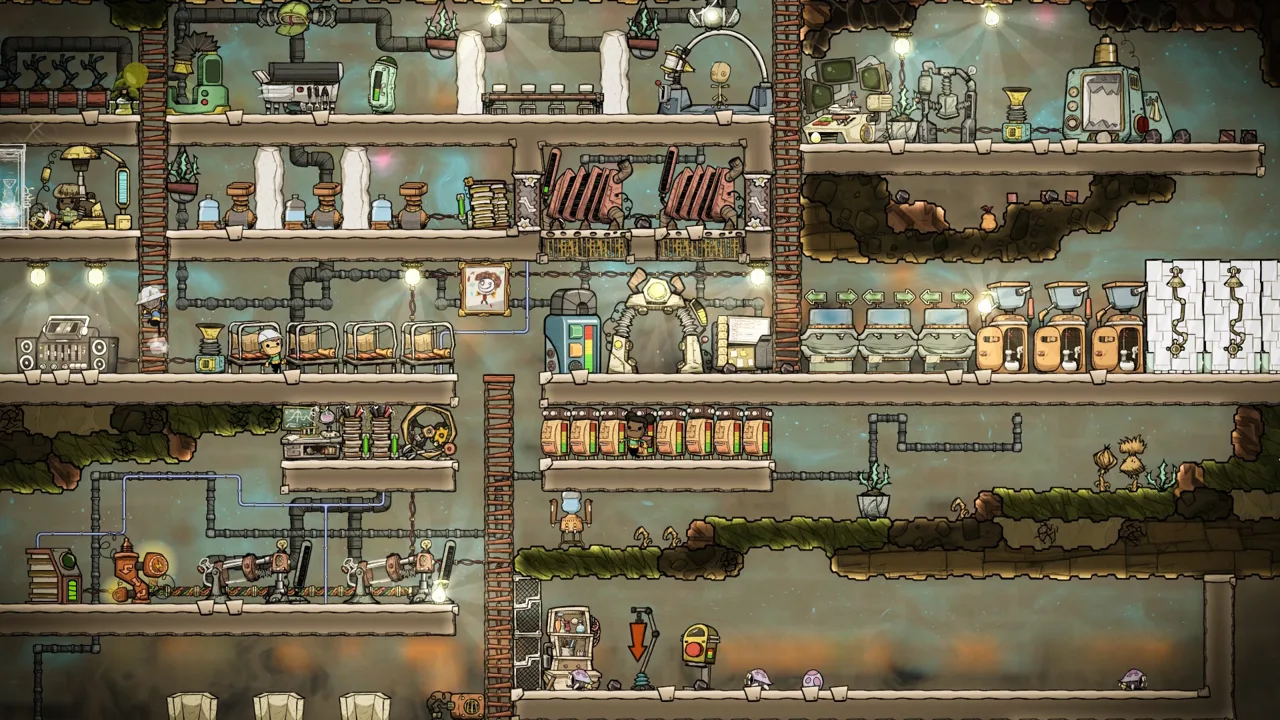 Image: Steam / Klei Entertainment
Think of each material as a water tank. The water level represents temperature, while the tank’s width represents specific heat capacity. Adding the same amount of water raises the level farther in a narrow tank.
That explains why temperature alone doesn’t tell you how much cooling a material needs. Mass matters too: a larger quantity requires more energy for the same temperature change.
The relationship is:
Heat transferred = mass × specific heat capacity × temperature change
For equal masses, aluminum has about twice iron’s specific heat capacity. Raising its temperature by the same amount therefore requires about twice the energy. Aluminum also conducts heat much more readily, demonstrating why heat capacity and conductivity need separate attention.
Apply that distinction when choosing materials:
- Choose higher heat capacity when you want a thermal buffer that changes temperature slowly.
- Choose higher conductivity when you want heat to move readily between a cooling loop and its surroundings.
- Choose low conductivity and insulated construction when you want to limit heat exchange.
High heat capacity delays temperature changes. It doesn’t provide permanent insulation.
Thermal Conductivity: Choose Pipes for Their Job
Conductivity works in both directions. A conductive pipe can cool a hot room when its contents are colder, or warm that room when its contents are hotter.
 Image: Steam / Klei Entertainment
Divide your pipe route by purpose: exchange heat at the destination, then limit unwanted exchange during transport.
Regular and Insulated Pipes
Granite is a useful conductor among the raw minerals used for regular pipes. Use granite sections where you want an economical cooling loop to exchange heat without spending refined metal throughout the route.
For insulated pipes, igneous rock is a common choice. Its low conductivity limits heat transfer, while its relatively high specific heat capacity makes the pipe itself slower to change temperature. Mafic rock has even lower conductivity.
The building type matters alongside the material. Insulated pipes lower the chosen material’s effective conductivity and use a different heat-transfer calculation from regular pipes.
Build insulated sections where preserving the packet’s temperature matters. Selecting a low-conductivity mineral for a regular pipe doesn’t give it the same behavior as an insulated pipe.
Radiant Liquid and Gas Pipes
Radiant liquid pipes use refined metals, while radiant gas pipes use metal ores. That difference changes which materials are available for each network.
- Use aluminum for strong heat transfer in radiant liquid pipes.
- Use copper, gold, or cobalt when aluminum isn’t readily available.
- Use steel for radiant gas pipes when you have access to it.
- Use thermium for demanding heat-exchange builds once it becomes available.
Liquid pipes also carry up to 10 kilograms per second, compared with 1 kilogram per second for gas pipes. That larger flow capacity is another advantage for liquid cooling loops.
Coolant Selection: Heat Capacity Changes Cooling Efficiency
Thermo Aquatuners and Thermo Regulators reduce the temperature of their contents by 14°C. Because that temperature drop is fixed, coolant heat capacity determines how much heat each processed packet transfers.
 Image: Steam / Klei Entertainment
A liquid with higher specific heat capacity moves more heat for the same mass and temperature drop. Choosing a conductive pipe solves heat exchange along the route; choosing a suitable coolant solves how much heat the loop carries.
| Cooling option | Relevant property | Practical selection |
|---|---|---|
| Water | High specific heat capacity | Use when the operating temperature stays safely within its liquid range |
| Polluted water | Water’s heat-capacity advantage with a wider liquid temperature range | Use for general cooling loops that need more temperature flexibility |
| Petroleum or crude oil | Lower specific heat capacity than water | Reserve for temperature requirements that justify the efficiency tradeoff |
| Supercoolant | Exceptionally high specific heat capacity | Use for advanced liquid cooling when available |
| Hydrogen | High specific heat capacity among practical cooling gases | Use in Thermo Regulator loops and Wheezewort cooling rooms |
Polluted water offers more flexibility than clean water because it tolerates a wider temperature range before changing state. Keep the coolant’s freezing and boiling limits in mind when setting your operating temperature.
Petroleum becomes useful for deep cooling beyond polluted water’s practical range before supercoolant is available. Avoid choosing it for an ordinary Aquatuner loop solely because it sounds like an industrial coolant.
Hydrogen fills a similar role for gas cooling. Thermo Regulators apply their 14°C temperature reduction, while Wheezeworts apply a 5°C reduction to the gas they process. Higher gas heat capacity increases the heat removed for that temperature change.
Diagnose Flow Problems Before Rebuilding the Loop
A better pipe material won’t solve a blocked network. Inspect circulation before replacing an entire cooling route with expensive metal.
The November 19, 2026 Quality of Life Update added several tools that help separate plumbing faults from temperature problems:
- Pipe Flow sub-overlays show flow direction and blockage locations in Plumbing and Ventilation.
- Pipes damaged by contents changing state display a status explaining the break.
- Thermo Aquatuners and Thermo Regulators display both Heat Source and Heat Sink icons in the Temperature overlay.
Use the flow display to locate a stoppage, then inspect packet temperatures and any damage message. If the coolant changes state, address its operating range. If circulation works but heat exchange is weak, inspect the pipe sections where cooling should happen and replace those sections with an appropriate conductive material.
Continue with
 Oxygen Not Included How to Make a Cooling System That WorksOxygen Not Included how to make a cooling system: build an Aquatuner loop, protect your crops, and control heat with a Steam Turbine and safe automation.
Continue exploring
Oxygen Not Included How to Store Water: Tank Guide
Oxygen Not Included how to store water: build liquid tanks, use 5-ton reservoirs, prevent pressure damage, and explore infinite storage before sealing up.

Oxygen Not Included Infinite Liquid Storage: 3 Builds
Build Oxygen Not Included infinite liquid storage with vent displacement, Escher waterfalls, or door compression. Learn how to contain pressure safely.
Join the community
Official channels for news, updates and player help: