
Oxygen Not Included How to Store Water: Tank Guide
Oxygen Not Included how to store water: build liquid tanks, use 5-ton reservoirs, prevent pressure damage, and explore infinite storage before sealing up.
Jump to
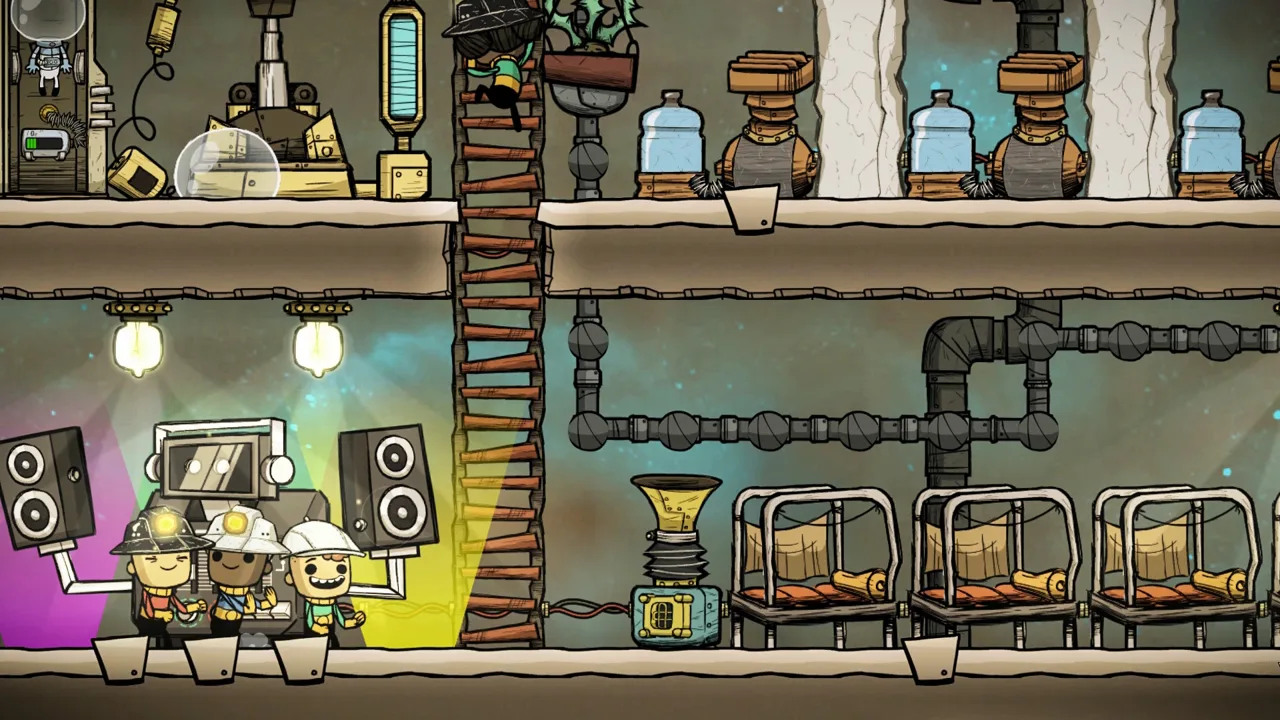
How Do You Store Water in Oxygen Not Included?
In Oxygen Not Included, how to store water comes down to two standard options: collect it in a tile-built tank or use a Liquid Reservoir. Add a Pitcher Pump for Duplicant collection or a powered Liquid Pump for plumbing. Reservoirs hold 5,000 kg each; ordinary water pools hold 1,000 kg per tile before compression.
Choose storage around how you intend to retrieve the water. A pool provides access for a Pitcher Pump.
| Storage method | Capacity | How you retrieve the water |
|---|---|---|
| Tile-built water tank | 1,000 kg per water tile before compression | Pitcher Pump for collection; Liquid Pump for pipes |
| Liquid Reservoir | 5,000 kg in a six-tile building footprint | — |
| Infinite liquid storage | Compresses water beyond ordinary tile mass | Internal Liquid Pump |
The reservoir’s six-tile footprint stores less water than six full water tiles. However, reservoirs can also sit inside a larger liquid tank, adding building storage within the same area.
Official page: Oxygen Not Included (klei.com)
Build a Water Tank With Pump Access
A tank needs containment, a way to fill it, and access to the stored water. Plan those parts before enclosing the space.
 Image: Steam / Klei Entertainment
- Create a contained basin. Build the floor and walls before directing water into it.
- Position your retrieval equipment. Arrange a Pitcher Pump so Duplicants can collect water, or place a Liquid Pump inside for piped delivery.
- Connect the plumbing. To transfer water from another pool, connect its powered Liquid Pump to a Liquid Vent in the receiving tank.
- Keep the outlet below the rim. Put the receiving vent below the surrounding wall tops so rising water can stop discharge before spilling over.
- Check access and flow. Make sure Duplicants can reach the collection point and that the pipe network delivers water where intended.
A Pitcher Pump and a Liquid Pump serve different jobs. The Pitcher Pump gives Duplicants water to carry; the Liquid Pump moves water through pipes. Include both when your colony needs both forms of access.
For a large, enclosed supply, pipe water into a separate collection basin with a Pitcher Pump. This lets you draw from storage without opening the main tank.
Prevent Pressure Damage
Water mass increases at the bottom of a tall tank. Enough pressure can damage its boundary tiles and eventually cause a breach.
Use Airflow Tiles or locked airlock doors where pressure resistance is required. These boundary types contain liquid and withstand liquid pressure.
Do not substitute Pneumatic Doors for airlocks. Their openings allow water through. Lock airlock doors used as tank walls so Duplicants cannot open a route for stored water to escape.
Connect Liquid Reservoirs to Your Plumbing
A Liquid Reservoir holds 5 tons, or 5,000 kg, and occupies six tiles.
 Image: Steam / Klei Entertainment
Use the capacity comparison when planning space: a reservoir provides a defined storage amount, while a pool’s capacity depends on its filled area and compression. Place reservoirs inside a tank when you want to combine those storage methods.
Reservoir automation also received a specific fix in the November 19, 2026 Quality of Life Update: matching high and low thresholds no longer cause the automation signal to alternate on and off.
Understand Infinite Water Storage Before Building It
Infinite liquid storage compresses water beyond its ordinary mass per tile by exploiting liquid displacement or vent behavior. These builds require pressure-resistant boundaries and a way to extract the water.
 Image: Steam / Klei Entertainment
Simply enclosing a Liquid Vent behind locked doors does not create infinite storage. The inlet must also use a working displacement or compression arrangement.
Small-Packet Liquid Storage
One method traps a small quantity of a different liquid at the inlet. In a water-storage design, a partial tile of Polluted Water can keep the Liquid Vent from registering the surrounding water’s full pressure.
The placement matters: the separate liquid must remain trapped at the vent rather than move away. The tank then needs Airflow Tiles or locked airlocks to withstand the increasing water pressure.
Install the extraction pump, power wire, and outlet pipe before sealing the chamber.
Escher Waterfall Storage
An Escher waterfall uses a particular arrangement of liquid and two different gases to keep water entering the storage chamber.
The setup begins with water in the storage and inlet areas. The critical gas cells then contain different gases arranged by density—for example, Oxygen above Carbon Dioxide.
Preserve the inlet geometry and gas positions when building this design. A random air pocket above a vent does not reproduce the same arrangement.
Door Compression
A sequence of automated doors can push water into storage and compress it. This method depends on the door sequence and automation timing.
Keep the receiving path open to the storage chamber: closing off the wrong end can turn a door compressor into a material-deletion mechanism.
Protect the Water Supply From Heat and Blockages
Storage capacity does not protect your equipment from temperature. Choose Liquid Pump materials with an overheat temperature suitable for the water being stored, and use Insulated Tiles where you need to reduce heat transfer.
For infinite storage, protect the separate liquid or gas arrangement that keeps the inlet operating. Freezing or evaporation can disrupt that setup.
When water stops moving, inspect the system in this order:
- Receiving vent: Check whether water around it has caused overpressure.
- Destination: Check whether the reservoir or receiving basin has filled.
- Extraction pump: Check its power connection, operating status, and temperature.
- Pipe route: Follow the line to locate the blockage.
Since the November 19, 2026 update, the Plumbing overlay includes Pipe Contents and Pipe Flow views with animated flow and blockage indicators. Use those views to trace stalled water, and inspect damage status messages when pipe contents change state.
Continue with
 Oxygen Not Included Infinite Liquid Storage: 3 BuildsBuild Oxygen Not Included infinite liquid storage with vent displacement, Escher waterfalls, or door compression. Learn how to contain pressure safely.
More in Water
Oxygen Not Included Pipe Blocked for No Reason: Fixes
Oxygen Not Included pipe blocked for no reason? Fix water flow by checking bridge direction, full cooling loops, bathroom overflow, and shutoff automation.
Oxygen Not Included Polluted Water: Clean It and Reuse
Manage Oxygen Not Included polluted water with a Water Sieve, reuse bathroom wastewater, control polluted oxygen, and remove germs for safe colony use.
Continue exploring

Join the community
Official channels for news, updates and player help: